


A Pharmacovigilance System Master File (PSMF) is one of the most important documents within a pharmacovigilance (PV) system. It provides a comprehensive description of how a company monitors, evaluates, and manages the safety of its medicinal products throughout their lifecycle.
Think of the PSMF as the blueprint of your pharmacovigilance system. Rather than documenting individual adverse events, it explains how the entire pharmacovigilance system operates, who is responsible for safety activities, the processes in place, the technologies used, and how compliance with regulatory requirements is maintained.
For pharmaceutical companies, maintaining an accurate and up-to-date PSMF is not just a regulatory expectation; it’s a critical component of demonstrating a solid quality system and commitment to patient safety.
Why is the Pharmacovigilance System Master File Important?
Every pharmaceutical company has a responsibility to continuously monitor the safety of its medicinal products after they reach the market. Regulatory authorities need assurance that companies have an effective pharmacovigilance system capable of detecting, assessing, understanding, and preventing adverse effects.
The PSMF provides that assurance.
During inspections, regulators often request the PSMF early in the inspection process because it offers an overview of the company’s entire pharmacovigilance system. An incomplete, outdated, or inaccurate PSMF may raise concerns about the effectiveness of the company’s safety management system.
A well-maintained PSMF demonstrates that the company:
- Has clearly defined pharmacovigilance responsibilities
- Operates an organized quality management system
- Maintains documented procedures for safety activities
- Monitors regulatory compliance
- Continuously improves its pharmacovigilance processes
- Prioritizes patient safety
What Does a Pharmacovigilance System Master File Contain?
Although regulatory requirements may differ slightly between regions, most Pharmacovigilance System Master Files include the following sections.
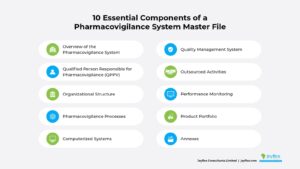
1. Overview of the Pharmacovigilance System Master File
This section introduces the company’s pharmacovigilance system and explains how safety activities are organized globally or locally.
It usually includes:
- Company structure
- Organizational charts
- Description of pharmacovigilance activities
- Scope of the pharmacovigilance system
2. Qualified Person Responsible for Pharmacovigilance (QPPV)
The PSMF identifies the person responsible for overseeing the pharmacovigilance system.
Information typically includes:
- Name and qualifications
- Contact details
- Responsibilities
- Deputy arrangements
- Reporting lines within the organization
This demonstrates that there is clear accountability for pharmacovigilance oversight.
3. Organizational Structure
Regulators expect companies to clearly define responsibilities within the pharmacovigilance system.
The PSMF often outlines:
- Pharmacovigilance department
- Medical affairs
- Regulatory affairs
- Quality assurance
- Clinical operations
- External service providers
- Local safety officers
Clear reporting relationships help demonstrate effective governance.
4. Pharmacovigilance Processes
A significant portion of the PSMF describes the procedures used to perform pharmacovigilance activities.
These include:
- Individual Case Safety Report (ICSR) management
- Literature monitoring
- Signal detection
- Risk management
- Aggregate reporting-PBRERs/PSURs
- Safety database management
- Medical information handling
- Product quality complaints with safety implications
- Safety communication
- Safety variations
- Training
- Vendor oversight
- Audit management
Each process should reference the relevant Standard Operating Procedures (SOPs).
5. Computerized Systems
Modern pharmacovigilance relies heavily on validated electronic systems.
The PSMF documents systems used for:
- Adverse event collection
- Safety databases
- Document management
- Literature screening
- Regulatory submissions
- Quality management
It should also explain system validation and data security measures.
6. Quality Management System
A solid Quality Management System (QMS) is the foundation of an effective pharmacovigilance system.
The PSMF should describe:
- SOP management
- Document control
- Change control
- Deviation management
- Corrective and Preventive Actions (CAPA)
- Internal audits
- Risk management
- Training programs
- Continuous improvement activities
This demonstrates how the company maintains compliance over time.
7. Outsourced Activities
Many companies outsource parts of their pharmacovigilance activities to local representatives or specialist pharmacovigilance providers.
The PSMF should identify:
- Service providers
- Scope of outsourced activities
- Contracts and agreements
- Oversight mechanisms
- Vendor qualification process
Even when activities are outsourced, the Marketing Authorization Holder (MAH) remains ultimately responsible for pharmacovigilance compliance.
8. Performance Monitoring
The PSMF explains how the company monitors the effectiveness of its pharmacovigilance system.
Examples include:
- Compliance metrics
- Case processing timelines
- Literature review performance
- Training completion
- Audit findings
- CAPA effectiveness
- Inspection outcomes
- Quality indicators
These metrics demonstrate ongoing oversight and continuous improvement.
9. Product Portfolio
The PSMF generally includes information about products covered under the pharmacovigilance system.
This may include:
- Authorized medicinal products
- Product categories
- Marketing authorization information
- Countries where products are marketed
Some regions require product lists to be maintained as annexes.
10. Annexes
Supporting documentation is usually maintained separately as annexes to simplify updates.
PSMF annexes include:
a) Qualified Person Responsible for Pharmacovigilance (QPPV)
b) Organizational Structure of the Marketing Authorization Holder, including any outsourced activities
c) Sources of safety data
d) Computerized systems and databases
e) Pharmacovigilance processes
f) Pharmacovigilance system performance
g) Quality System
h) List of Products covered by the PSMF
i) Document and Record Control
When Should a Pharmacovigilance System Master File (PSMF)Be Updated?
A Pharmacovigilance System Master File is considered a living document. It should always reflect the current pharmacovigilance system.
Updates are necessary whenever significant changes occur, including:
- Appointment of a new QPPV
- Organizational restructuring
- Introduction of new safety databases
- Changes to pharmacovigilance processes
- Addition of new products
- New outsourcing arrangements
- Regulatory changes
- Inspection findings requiring updates
Regular periodic reviews also help ensure continued accuracy.
Common PSMF Mistakes
Many inspection findings relate not to the absence of a PSMF, but to poor maintenance.
Common issues include:
1. Outdated Information
Organizational changes, new personnel, or revised procedures are not reflected promptly.
2. Inconsistent Information
Details in the PSMF differ from SOPs, contracts, or quality records.
3. Missing Documentation
Important annexes, vendor lists, or
product inventories are incomplete.
4. Weak Oversight of Vendors
Outsourced pharmacovigilance activities are poorly documented or insufficiently monitored.
5. Poor Version Control
Companies cannot demonstrate which version of the PSMF is current.
6. Lack of Evidence
Processes described in the PSMF are not supported by documented procedures or quality records.
How Does the PSMF Support Regulatory Inspections?
During pharmacovigilance inspections, inspectors use the PSMF as a roadmap to understand how a company’s safety system functions.
Inspectors often verify whether:
- Actual practices match the documented system
- Responsibilities are clearly assigned
- SOPs support described processes
- Training records are current
- Vendors are adequately managed
- CAPAs are effectively implemented
- Quality metrics are monitored
- Documentation is consistent across departments
A well-maintained PSMF can significantly streamline inspections by providing inspectors with a clear and accurate picture of the pharmacovigilance system.
Best Practices for Maintaining a PSMF
Maintaining a compliant PSMF requires ongoing attention rather than a once-off exercise. Consider these best practices:
- Assign clear ownership for maintaining the PSMF.
- Review the document at regular intervals, even if no major changes have occurred.
- Update the PSMF immediately after significant organizational or process changes.
- Ensure consistency between the PSMF, SOPs, quality records, and regulatory documentation.
- Maintain proper version control and document approval records.
- Conduct internal audits to verify that the documented pharmacovigilance system reflects actual practice.
- Train relevant staff on the importance of the PSMF and their responsibilities in keeping information accurate.
- Keep annexes organized and easy to update to reduce administrative burden.
How Jeyflex Consultants Can Help
Developing and maintaining a Pharmacovigilance System Master File can be challenging, particularly for organizations operating across multiple markets or those building a pharmacovigilance system for the first time.
At Jeyflex Consultants Ltd., we support pharmaceutical companies in establishing, reviewing, and maintaining compliant pharmacovigilance systems. Our services include:
- Development of Pharmacovigilance System Master Files (PSMFs)
- PSMF gap assessments and reviews
- Pharmacovigilance Quality Management System implementation
- SOP development and review
- Pharmacovigilance audits
- Vendor oversight support
- Pharmacovigilance training
- Regulatory compliance consulting
Our experienced team helps organizations strengthen their pharmacovigilance systems while ensuring alignment with applicable regulatory requirements and industry best practices.
Final Thoughts
A Pharmacovigilance System Master File (PSMF) is far more than a regulatory document—it is the foundation that demonstrates how a pharmaceutical company protects patients through an effective pharmacovigilance system.
An accurate, well-organised, and regularly updated PSMF supports regulatory compliance, facilitates inspections, strengthens quality management, and builds confidence with regulators, partners, and patients alike.
As regulatory expectations continue to evolve, organizations that proactively maintain their PSMF will be better positioned to demonstrate compliance, manage risks effectively, and uphold the highest standards of patient safety.
Article by: Marraret Ouma