

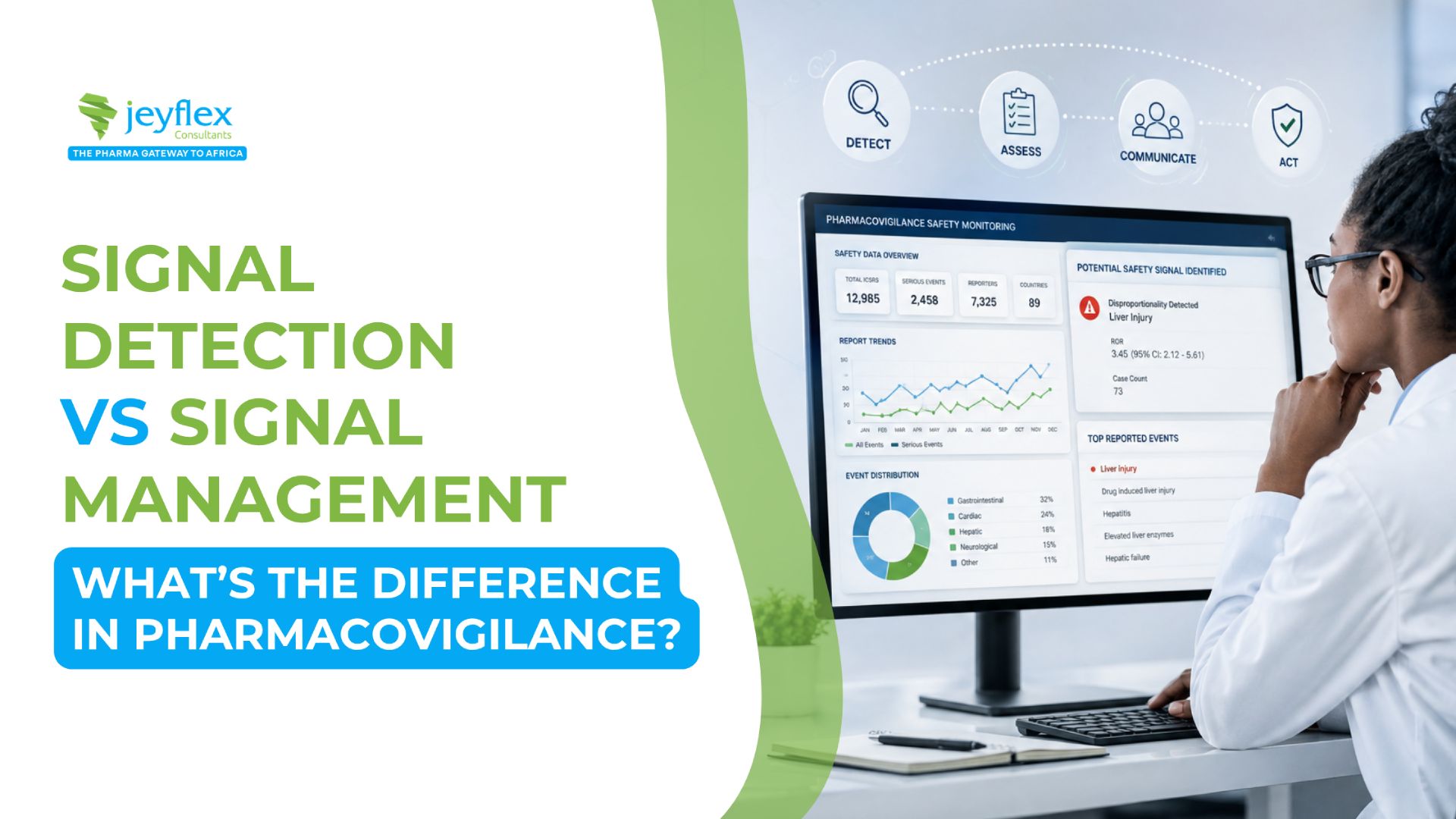
Signal Management vs Signal Detection is one of the most frequently misunderstood topics in pharmacovigilance. In our previous blog, Signal Detection and Management in Pharmacovigilance, we explored how pharmaceutical companies identify, evaluate, and respond to potential safety concerns associated with medicinal products.
However, during our pharmacovigilance training programmes and interactions with pharmaceutical professionals across Africa, one question consistently comes up:
“What exactly is the difference between signal detection and signal management?”
At first glance, the terms seem interchangeable. After all, both relate to identifying and addressing potential safety concerns. Yet from a regulatory and operational perspective, they serve very different purposes within a pharmacovigilance system.
Understanding the distinction is important because regulatory authorities expect Marketing Authorization Holders (MAHs) to have solid systems not only for identifying potential safety signals but also for evaluating and managing them appropriately.
So, let’s take a closer look at Signal Management vs Signal Detection and understand how these two concepts fit into the broader pharmacovigilance framework.
A Story from Everyday PV Activities
Imagine you are a pharmacovigilance associate reviewing adverse event reports for a newly approved medicine. While analyzing the monthly safety data, you notice something unusual.
Three reports from different hospitals describe a similar adverse reaction that was not observed during clinical trials. At first glance, it may seem like a coincidence. However, the similarity of the cases catches your attention.
You flag the issue and inform the safety team. At this point, you have detected a signal.
The safety team then reviews the cases, examines additional reports, evaluates scientific literature, consults medical experts, assesses the product’s benefit-risk profile, and determines whether regulatory action is necessary.
This broader process is known as signal management. In simple terms:
Signal detection identifies a potential problem, while Signal management investigates the problem and determines what should happen next.
What Is Signal Detection?
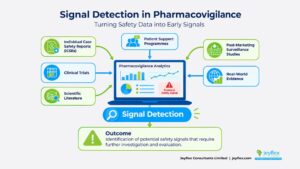
Signal detection is the process of identifying potential safety signals from available data.
A safety signal is information that suggests a possible new association, or a new aspect of a known association, between a medicine and an adverse event that requires further investigation.
Simply put, signal detection is about finding clues. It is the process of reviewing safety data and asking, “Is there something unusual happening that we need to investigate?” These clues can come from various sources, including:
- Individual Case Safety Reports (ICSRs)
- Scientific literature
- Clinical trials
- Patient support programmes
- Post-marketing surveillance studies
- Safety databases such as VigiBase, EudraVigilance, and FAERS
- Real-world evidence
Signal detection may involve:
Reviewing Individual Cases
A safety reviewer may identify unusual patterns while assessing adverse event reports.
Statistical Data Mining
Large safety databases can be analysed using disproportionality methods such as: Reporting Odds Ratio (ROR), Proportional Reporting Ratio (PRR), Bayesian analyses.
Medical and Scientific Review
Clinical experts assess whether observed events are biologically plausible and medically meaningful.
The outcome of signal detection is straightforward:
A potential signal has been identified and requires further evaluation.
At this stage, no conclusions have been made. Think of signal detection as spotting smoke in the distance. You know something may be happening, but you do not yet know whether there is a fire.
What Is Signal Management?
Once a potential signal has been identified, it enters a structured process designed to determine whether the concern is genuine and what actions, if any, should be taken.
Signal management is therefore much broader than signal detection. In fact, signal detection is one component of the overall signal management process.
Signal management includes all activities from identifying a signal through to regulatory action and ongoing monitoring.
The Journey from Signal to Action
Returning to our earlier example of the liver injury reports, the pharmacovigilance team now needs answers.
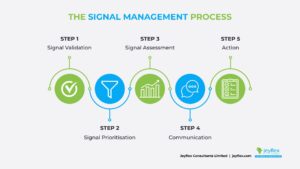
Step 1: Signal Validation
The team first determines whether the signal is credible. Questions include:
- Is the information reliable?
- Is the event already known?
- Is there enough evidence to justify further investigation?
Not every potential signal becomes a validated signal. Some are dismissed because the available evidence is insufficient.
Step 2: Signal Prioritisation
Validated signals are prioritised according to: Seriousness, Frequency, Potential public health impact and Regulatory importance. Resources can then be focused on the most significant risks.
Step 3: Signal Assessment
A detailed scientific review is conducted. The team may evaluate:
- Individual case reports
- Clinical trial data
- Published literature
- Epidemiological evidence
- Benefit-risk considerations
The goal is to determine whether a causal relationship is likely.
Step 4: Communication
If the signal is confirmed, relevant stakeholders must be informed. This may include:
- Regulatory authorities
- Healthcare professionals
- Patients
- Internal company stakeholders
Step 5: Action
Depending on the findings, actions may include:
- Updating product information
- Revising warnings and precautions
- Updating Risk Management Plans (RMPs)
- Conducting additional studies
- Issuing safety communications
- Restricting product use
In rare cases, products may even be withdrawn from the market.
Signal Detection vs Signal Management
| Signal Detection | Signal Management |
| Identifies potential safety concerns | Evaluates and manages safety concerns |
| Focuses on finding unusual patterns | Focuses on understanding and acting on those patterns |
| First step in the process | Complete end-to-end process |
| Uses data review and statistical methods | Uses validation, assessment, communication, and action |
| Produces potential signals | Produces regulatory and risk minimisation decisions |
A simple way to remember the difference is: Signal detection identifies the question and Signal management finds the answer.
Why the Difference Matters
Many organizations invest heavily in signal detection technologies and databases, which are certainly important. However, technology alone cannot protect patients.
A software platform may identify a statistical association, but it cannot independently determine:
- Whether the association is clinically meaningful
- Whether a medicine caused the event
- Whether regulatory action is necessary
- How risks should be communicated
These decisions require experienced pharmacovigilance professionals, medical reviewers, and regulatory experts. This is why regulators increasingly focus not only on signal detection capabilities but also on the effectiveness of an organization’s signal management framework.
Building a Strong Signal Management System
An effective pharmacovigilance system should include:
- Clearly documented signal management procedures
- Regular signal review meetings
- Access to multiple safety data sources
- Qualified pharmacovigilance personnel
- Effective documentation practices
- Solid communication pathways
Organizations that excel in these areas are better equipped to identify emerging risks and take timely action to protect patients.
Final Thoughts
Signal detection and signal management are closely linked, but they are not interchangeable terms.
Signal detection is about identifying potential safety concerns. Signal management is the broader process of validating, assessing, communicating, and acting upon those concerns.
Going back to our opening story, identifying the three liver injury reports was an example of signal detection. Everything that followed, from investigation to regulatory action, was signal management.
Understanding this distinction helps pharmaceutical companies strengthen their pharmacovigilance systems, improve compliance, and most importantly, protect patient safety.
Need Expert Support with Signal Detection and Signal Management?
At Jeyflex Consultants Ltd, we help pharmaceutical companies establish and maintain effective pharmacovigilance systems that meet global regulatory requirements and protect patient safety.
Whether you are strengthening your signal management processes or building a pharmacovigilance system from the ground up, our team is ready to support you.
Contact Jeyflex Consultants today and discover how our pharmacovigilance experts can help you stay compliant, inspection-ready, and focused on patient safety.
Article by: Marraret Ouma.