

The role of pharmacovigilance in patient safety has never been more important. Every day, millions of people rely on medicines to prevent, treat, and manage diseases. While medicines undergo extensive testing before approval, some risks only become apparent after they are used by larger and more diverse populations. This is where pharmacovigilance plays a vital role, continuously monitoring medicine safety, identifying adverse drug reactions, and helping protect patients worldwide.
This is where Pharmacovigilance (PV) steps in, the often unseen but essential system that continuously monitors the safety of medicines and protects public health.
The Role of Pharmacovigilance in Patient Safety
What is Pharmacovigilance?
The World Health Organization (WHO) defines pharmacovigilance as:
“The science and activities relating to the detection, assessment, understanding, and prevention of adverse effects or any other drug-related problems.”
In simple terms, pharmacovigilance ensures that medicines remain as safe and effective as possible throughout their lifecycle. It involves collecting safety information, investigating adverse reactions, identifying risks, and taking action to protect patients.
Every report, no matter how small, contributes to a larger picture that helps healthcare professionals, regulators, and pharmaceutical companies make informed decisions about medicine safety.
Why Does Pharmacovigilance Exist?
Many people assume that once a medicine is approved, all potential risks are already known. However, drug development and clinical trials have limitations.
1. Clinical Trials Have Limitations
Before approval, medicines are tested on carefully selected groups of participants. While these studies are rigorous, they often involve:
- A limited number of patients
- Short study durations
- Specific patient populations
As a result, uncommon or long-term side effects may not be detected during development.
2. Real-World Use Reveals More Information
Once a medicine enters the market, it may be used by millions of people of different ages, medical conditions, lifestyles, and genetic backgrounds.
A medicine that appeared safe during clinical trials may behave differently when used in diverse populations.
3. New Risks Can Emerge
Some adverse effects are extremely rare and only become visible after large-scale use. Others may appear after prolonged treatment or when medicines are combined with other therapies.
4. Continuous Monitoring Protects Patients
Pharmacovigilance provides an ongoing system to monitor medicines and ensure that their benefits continue to outweigh their risks.
The Historical Event That Changed Drug Safety Forever
To understand the importance of pharmacovigilance, we must revisit one of the most significant tragedies in pharmaceutical history: the Thalidomide Disaster.
The Story of Thalidomide
In the late 1950s, thalidomide was marketed as a safe sedative and was commonly prescribed to pregnant women for morning sickness.
Initially, the medicine was considered safe. However, doctors soon began noticing an alarming increase in babies born with severe limb deformities and other congenital abnormalities.
Thousands of children worldwide were affected.
The tragedy shocked the medical community and exposed weaknesses in medicine safety monitoring systems.
Lessons Learned
The thalidomide incident led to:
- Stronger regulatory requirements
- More rigorous drug safety evaluations
- Enhanced post-marketing surveillance
- The establishment of modern pharmacovigilance systems
Today, many of the safety measures we take for granted exist because of the lessons learned from this event.
Understanding Key Pharmacovigilance Terms
What is a Drug?
A drug is any substance used for the diagnosis, prevention, and treatment of disease.
Examples include Paracetamol, Amoxicillin and Metformin
What is an Adverse Drug Reaction (ADR)?
An Adverse Drug Reaction (ADR) is a harmful and unintended response to a medicine when it is used at normal doses.
Example:
A patient develops a skin rash after taking paracetamol. In this case, the reaction is directly linked to the medicine.
What is an Adverse Event (AE)?
An Adverse Event (AE) is any undesirable medical occurrence that happens after a medicine is used.
Importantly, the event may or may not be caused by the medicine.
Example:
A patient experiences a headache after taking medication, but it is not yet known whether the medication caused it.
ADR vs AE: Understanding the Difference
Many people use the terms ADR and AE interchangeably, but they are not the same.
| ADR (Adverse Drug Reaction) | AE (Adverse Event) |
| Drug-related | May or may not be drug-related |
| Harmful and unintended response | Any undesirable medical occurrence |
| Occurs at normal doses | Causality not yet confirmed |
| Relationship with medicine established | The relationship with medicine is uncertain |
Understanding this distinction is critical for accurate safety reporting and assessment
The Main Goals of Pharmacovigilance
Pharmacovigilance is not simply about collecting reports—it is about improving healthcare outcomes.
1. Improve Patient Care
By identifying and managing medicine-related risks, pharmacovigilance helps ensure safer treatment for patients.
2. Improve Public Health
Reducing medicine-related illnesses and deaths contributes to stronger healthcare systems and healthier communities.
3. Detect New Adverse Drug Reactions
Continuous monitoring helps identify previously unknown side effects that may not have been detected during clinical trials.
4. Assess the Benefit-Risk Balance
Every medicine has benefits and risks. Pharmacovigilance helps determine whether the therapeutic benefits continue to outweigh potential harms.
5. Promote the Safe Use of Medicines
Healthcare professionals and patients rely on safety information to make informed treatment decisions.
6. Prevent Future Harm
Early detection of safety concerns allows timely interventions before larger populations are affected.
How the Pharmacovigilance Process Works
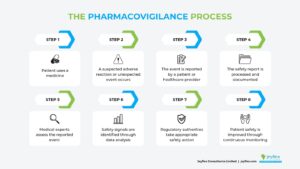
The pharmacovigilance process can be likened to a chain in which every link matters.
Step 1: The Patient Uses a Medicine
The process begins when a patient receives treatment.
Step 2: An Adverse Drug Reaction Occurs
The patient may experience a suspected side effect or unexpected medical event.
Step 3: The Event is Reported
Reports can come from healthcare professionals, patients, caregivers and pharmaceutical companies.
Step 4: Case Processing
The pharmacovigilance team collects and evaluates the information to ensure completeness and accuracy.
Step 5: Assessment
Medical experts assess the seriousness, expectedness, and potential relationship between the medicine and the reported event.
Step 6: Signal Detection
When multiple reports suggest a potential new risk, a safety signal may be identified.
Step 7: Regulatory Action
Authorities may take action such as updating product labels, adding warnings, restricting use, requesting additional studies, and suspending or withdrawing products when necessary.
Step 8: Improved Patient Safety
The ultimate goal is protecting patients and ensuring the continued safe use of medicines.
Key Pharmacovigilance Activities
Modern pharmacovigilance involves several interconnected activities.
Safety Data Collection
Collecting reports of suspected adverse drug reactions from healthcare professionals, patients, and other stakeholders.
Case Processing and Evaluation
Reviewing individual case safety reports and ensuring accurate documentation.
Signal Detection
Identifying patterns that may indicate emerging safety concerns.
Risk Assessment
Evaluating the significance and impact of identified risks.
Risk Minimization
Implementing measures such as safety warnings, Label changes, Educational materials, and Risk Management Plans (RMPs)
Safety Communication
Sharing important safety information with regulators, healthcare professionals, and the public.
Periodic Safety Update Reports (PSURs)
Preparing comprehensive reports that summarize a medicine’s global safety profile.
Regulatory Decision-Making
Supporting evidence-based decisions that protect public health while maintaining access to beneficial medicines.
Why Every Safety Report Matters
A single report may seem insignificant.
A patient experiences dizziness after taking a medicine. A nurse reports an unusual reaction. A pharmacist notices a pattern among several patients. Individually, these events may not tell a complete story.
Together, they can reveal a previously unknown safety concern that protects thousands, or even millions, of future patients. This is the power of pharmacovigilance.
Every report contributes to a global network of medicine safety monitoring.
The Future of Pharmacovigilance
As healthcare becomes increasingly digital, pharmacovigilance continues to evolve. Artificial intelligence, big data analytics, electronic health records, and real-world evidence are transforming how safety signals are detected and managed.
However, the core mission remains unchanged: To ensure that every patient receives the maximum possible benefit from medicines while minimizing risk.
Understanding the role of pharmacovigilance in patient safety helps healthcare professionals, pharmaceutical companies, and regulators work together to improve medicine safety and protect public health.
At Jeyflex Consultants Ltd., we understand the role of pharmacovigilance in patient safety and help pharmaceutical companies build compliant, effective pharmacovigilance systems. From Individual Case Safety Report (ICSR) processing and literature monitoring to signal detection, QPPV support, pharmacovigilance audits, and regulatory compliance, our experts are ready to support your organization.
Contact Jeyflex Consultants Ltd. today to learn how our pharmacovigilance services can strengthen your safety systems, ensure regulatory compliance, and protect patients across Africa.
Article by Marraret Ouma