

Regulatory Affairs and Pharmacovigilance Training has become essential in today’s rapidly evolving pharmaceutical industry. Regulatory requirements continue to change, pharmacovigilance responsibilities are expanding, and regulatory authorities are placing greater emphasis on compliance, patient safety, and product quality.
As a result, continuous learning is no longer optional for Regulatory Affairs (RA) and Pharmacovigilance (PV) professionals. Whether you are a pharmaceutical manufacturer, Marketing Authorisation Holder (MAH), healthcare professional, distributor, or regulatory professional, staying current with industry requirements is critical for maintaining compliance and ensuring patient safety.
Understanding the Link Between Regulatory Affairs and Pharmacovigilance
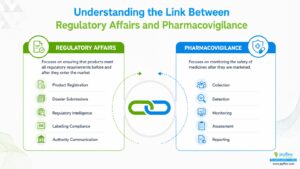
Although Regulatory Affairs and Pharmacovigilance are often treated as separate departments, they work very closely together throughout the lifecycle of a product.
Regulatory Affairs focuses on ensuring that products meet all regulatory requirements before and after they enter the market. This includes product registration, dossier submissions, variations, renewals, regulatory intelligence, labelling compliance, and communication with regulatory authorities.
Pharmacovigilance, on the other hand, focuses on monitoring the safety of medicines after they are marketed. It involves the collection, assessment, monitoring, and reporting of adverse drug reactions and other safety-related information.
The two functions are deeply interconnected. For example, safety data generated through pharmacovigilance activities may lead to regulatory actions such as label updates, safety warnings, risk minimisation measures, or even product recalls. At the same time, pharmacovigilance activities themselves must comply with strict regulatory requirements.
Because of this relationship, professionals in both areas benefit greatly from continuous learning and practical industry training.
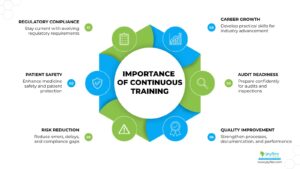
6 Reasons Why Continuous Training is Important
1. Keeping Up With Regulatory Changes
One of the biggest challenges in the pharmaceutical industry is the constant change in regulations and compliance expectations. Regulatory authorities across different countries regularly update their guidelines, submission requirements, safety reporting timelines, and inspection procedures.
Without regular training, it becomes difficult for professionals and companies to stay compliant with evolving requirements.
Training programmes help professionals remain updated on:
- Current regulatory guidelines
- Pharmacovigilance obligations
- Safety reporting requirements
- Good Pharmacovigilance Practices (GVP)
- Regulatory intelligence updates
- Audit and inspection readiness
- Risk management expectations
Training programmes help professionals remain updated on current regulatory guidelines, safety reporting requirements, and Good Pharmacovigilance Practices (GVP).
2. Improving Patient Safety
At the centre of pharmacovigilance is patient safety. Every adverse event report, safety review, or signal detection activity contributes to protecting patients from potential medicine-related harm.
However, effective pharmacovigilance depends heavily on the competence of the people handling safety activities. If staff are not adequately trained, important safety information may be missed, delayed, or incorrectly assessed.
Proper PV training helps professionals:
- Understand adverse event reporting requirements
- Detect and assess safety signals effectively
- Maintain accurate safety documentation
- Meet reporting timelines
- Support benefit-risk evaluations
Ultimately, better-trained professionals contribute to stronger pharmacovigilance systems and safer healthcare outcomes.
3. Reducing Compliance Risks for Pharmaceutical Companies
Regulatory non-compliance can have serious consequences for pharmaceutical companies. Delayed submissions, incomplete documentation, missed reporting timelines, or poor inspection outcomes can result in financial losses, reputational damage, warning letters, or suspension of products.
Many of these issues arise not because companies lack resources, but because teams are not adequately trained on current requirements and expectations.
Continuous RA and PV training helps organizations:
- Improve documentation quality
- Strengthen internal processes
- Prepare for audits and inspections
- Maintain effective quality systems
- Reduce operational errors
- Improve overall compliance culture
Well-trained teams are more confident, efficient, and better prepared to handle regulatory responsibilities.
4. Supporting Career Growth and Professional Development
The demand for skilled Regulatory Affairs and Pharmacovigilance professionals continues to grow both in Africa and globally. Pharmaceutical companies are increasingly looking for individuals who not only understand theoretical concepts but can also apply practical knowledge in real-world regulatory environments.
Training programmes provide professionals with valuable practical skills and industry exposure that support career growth.
Professionals who invest in continuous learning are often better positioned for roles such as:
- Regulatory Affairs Officer
- Pharmacovigilance Officer
- QPPV
- Drug Safety Associate
- Regulatory Intelligence Specialist
- Compliance Officer
- Medical Information Associate
Continuous professional development also demonstrates commitment to industry standards and professional excellence.
5. Preparing for Audits and Inspections
Regulatory authorities are paying closer attention to both Regulatory Affairs and Pharmacovigilance systems during inspections and audits. Companies are expected to demonstrate proper documentation, staff competency, effective safety systems, and compliance with applicable regulations.
Training helps organizations prepare staff to confidently handle:
- Regulatory inspections
- Pharmacovigilance audits
- CAPA implementation
- Documentation reviews
- Safety database requirements
- SOP compliance
A knowledgeable team can significantly improve inspection readiness and reduce compliance gaps.
6. Strengthening the Pharmaceutical Industry in Africa
Africa’s pharmaceutical industry is experiencing significant growth, with increasing investment in local manufacturing, product registration, and healthcare systems. As the industry expands, there is growing demand for qualified professionals who understand both regional and international regulatory expectations.
Training programmes play a critical role in building local capacity and strengthening pharmaceutical systems across the continent.
By investing in training, organizations contribute to:
- Better regulatory compliance
- Improved medicine safety monitoring
- Higher quality standards
- Stronger healthcare systems
- Increased patient confidence in medicines
Why Practical Industry Training Matters in Regulatory Affairs and Pharmacovigilance
The most effective training programmes are those that combine theory with practical industry experience. Professionals benefit more from training that addresses real-life regulatory and pharmacovigilance challenges rather than purely academic concepts.
Practical training helps participants understand how to apply regulatory and safety requirements in their day-to-day responsibilities, improving both competence and confidence.
Why Choose Jeyflex Consultants Ltd. for RA and PV Training?
Jeyflex Consultants Ltd. is an ISO-certified consultancy firm committed to supporting pharmaceutical professionals and organizations through high-quality Regulatory Affairs and Pharmacovigilance training programmes.
Our training programmes in both RA and PV are CPD-accredited by the Pharmacy and Poisons Board, ensuring participants receive industry-relevant, practical, and recognized professional training.
The programmes are designed to provide:
- Practical industry knowledge
- Real-world case studies
- Current regulatory and pharmacovigilance updates
- Hands-on learning experiences
- Expert guidance from industry professionals
Whether you are looking to strengthen your compliance systems, build staff competency, or advance your career in the pharmaceutical industry, our training programmes are designed to equip you with the skills and confidence needed in today’s regulatory environment.
Final Thought
In today’s pharmaceutical environment, continuous training in Regulatory Affairs and Pharmacovigilance is essential for maintaining compliance, improving patient safety, and supporting professional growth.
As regulations continue to evolve and regulatory expectations become more demanding, organizations and professionals must prioritize continuous learning to remain competitive and compliant.
Investing in training not only strengthens individual careers but also contributes to stronger pharmaceutical systems, safer medicines, and improved healthcare outcomes.
Ready to Advance Your Regulatory Affairs and Pharmacovigilance Skills?
Join Jeyflex Consultants Ltd.’s PPB CPD-accredited training programmes and gain practical, industry-relevant knowledge from experienced professionals.
Whether you are a beginner looking to build a career in RA or PV, or an experienced professional seeking to strengthen your expertise, our programmes are designed to help you stay compliant, competitive, and confident in today’s pharmaceutical industry.
Contact Jeyflex Consultants Ltd. today to learn more about upcoming training programmes and take the next step in your professional growth.
Article by Marraret Ouma